CSP-15 Cold Press Oil Machine
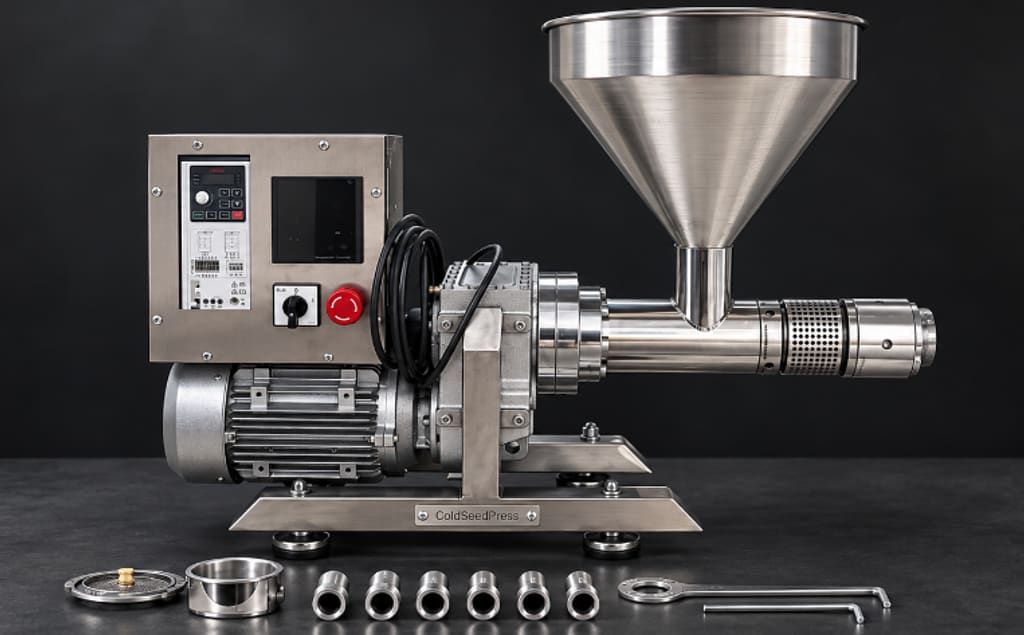
Cold press oil machine
CSP-15
Built for your production scale
- Efficient throughput
- 13–15 kg/h
- Rated daily capacity
- 360 kg / 24 h
- Operating power draw
- 1,000–1,750 W
- Residual oil in cake
- ≤5%
Manufacturer-stated figures
CSP-15 commercial cold press oil machine from ColdSeedPress. Mid-capacity screw press, 220V single phase, low residual oil in cake. Request a quote.
Overview
The CSP-15 is a mid-range commercial cold press screw machine, built for a shop or small mill that has outgrown a starter press but is not ready for three-phase infrastructure. It runs on a standard 220V single-phase supply and presses oilseeds and nuts without external heat input beyond the barrel heater used at start-up. It is the first model in the range that leaves less oil behind in the cake, which is what most buyers at this size are actually paying for.
What you can produce with it
Read the capacity as seed going in, not oil coming out. At the efficient rate, one eight-hour shift puts roughly 105 to 120 kg of seed through the machine. Two shifts roughly doubles that, and the 24-hour rating in the table assumes near-continuous running with normal pauses for cleaning and cooling.
For a small producer, that is the difference between batch work and a real production schedule. A day of pressing can cover a week of retail bottling for a farm shop, or a repeating wholesale order for a food producer. If you are buying seed by the sack and selling oil by the bottle, plan your purchasing around seed kilograms per shift rather than litres per hour, because oil volume depends on the seed you feed it.
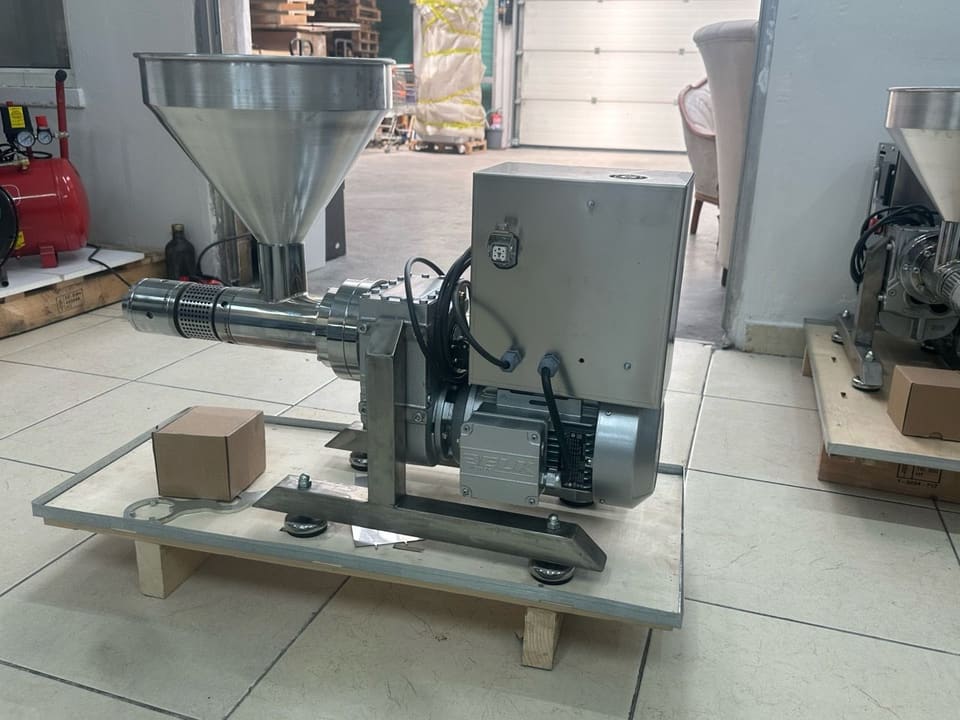
The press is heavy for its size and is meant to sit on a fixed bench or steel frame, bolted or braced. It is not a machine you move between rooms during the day.
Power supply
The CSP-15 is single phase. It connects to the same class of supply as the smaller models in the range, which is why many buyers step up to this capacity instead of moving to the three-phase CSP-30.
Check your supply before you order, in writing. This is the most common and most expensive mistake in export orders. Three things matter:
- Voltage. Confirm the actual voltage at the socket you will use, not the nominal figure for your country.
- Frequency. Tell us whether your grid is 50 Hz or 60 Hz when you request the quote. Motor behaviour is not identical on both.
- Circuit capacity and stability. Add the motor and the heater together, then confirm the circuit and any generator can carry the starting load, not just the running load. If your site runs on a generator or has frequent voltage dips, say so before we quote.
A machine that arrives wired for the wrong supply is a customs and warranty problem, not a quick fix.
Cold pressing and cake residue
Cold pressing means the seed is not roasted or solvent-treated. The oil leaves the press with its natural colour and aroma, and it needs settling or filtering before bottling.
Residual oil in the cake is the number to watch commercially. It tells you how much oil stayed in the solid press cake instead of running out of the machine. Lower residue means more oil recovered from every kilogram of seed you bought, and on a mid-capacity press that difference compounds quickly across a season. The CSP-15 sits below the smaller models in the range on this figure, which is the main reason to choose it over a lighter machine at similar voltage.
The cake itself is not waste. Pressed cake is normally sold as animal feed, and in some markets it is milled for food use. A cake with a modest amount of oil still in it remains a saleable feed product, so the press gives you two revenue streams from one input. Confirm local feed regulations for the seed you press before selling cake into the feed market.
Seeds
The CSP-15 is stated to handle black cumin (nigella), sesame, flax and linseed, safflower, sunflower, pumpkin seed, walnut, almond, chia, hazelnut, peanut, canola and rapeseed, tea seed, argan, avocado, coconut and copra, soy, hemp seed, and passion fruit seed.
Real throughput is not the same for every seed. Oil content, moisture, hardness, shell and cleanliness all change how fast the seed moves through the barrel and how well it presses. A hard, low-oil seed will run slower than a soft, oily one. Moisture that is too high or too low will hurt both speed and recovery.
We do not publish per-seed figures, because they would be misleading for your specific crop. Send us your seed and we will test it on request, then tell you what to expect from your own material.
What to check before you order
Use this list when you compare suppliers, not only when you talk to us.
- Electrical. Voltage, frequency, plug or terminal type, and circuit rating at the installation point. Get the answer from your electrician, not from the building plan.
- Spare parts. Ask which parts are treated as wear parts, how they are ordered, and whether a starting set can be added to the same shipment. Parts that travel with the machine avoid a second freight cost later.
- Documentation. Ask for the operating and maintenance manual in a language your operators read, the electrical and wiring information, the parts list with part identifiers, and the commercial documents your customs broker will need for import. If your market requires specific conformity documents for imported machinery, ask what documentation can be supplied and confirm it before shipping rather than after.
- Packing and shipping. Ask how the machine is crated, the gross weight and crate dimensions, whether it is palletised for forklift handling, and which Incoterm the quotation uses. Confirm who arranges inland transport at the destination and who clears customs.
- Installation and operation. Confirm what you must prepare on site: bench or frame, clearance around the machine, ventilation, and a place for oil settling and cake collection.
- Support. Agree in advance how technical questions are handled after delivery, and in which language.
Request a quote
Tell us your seed, your target output per shift, and your exact voltage and frequency, and we will prepare a quotation for the CSP-15 for your site.