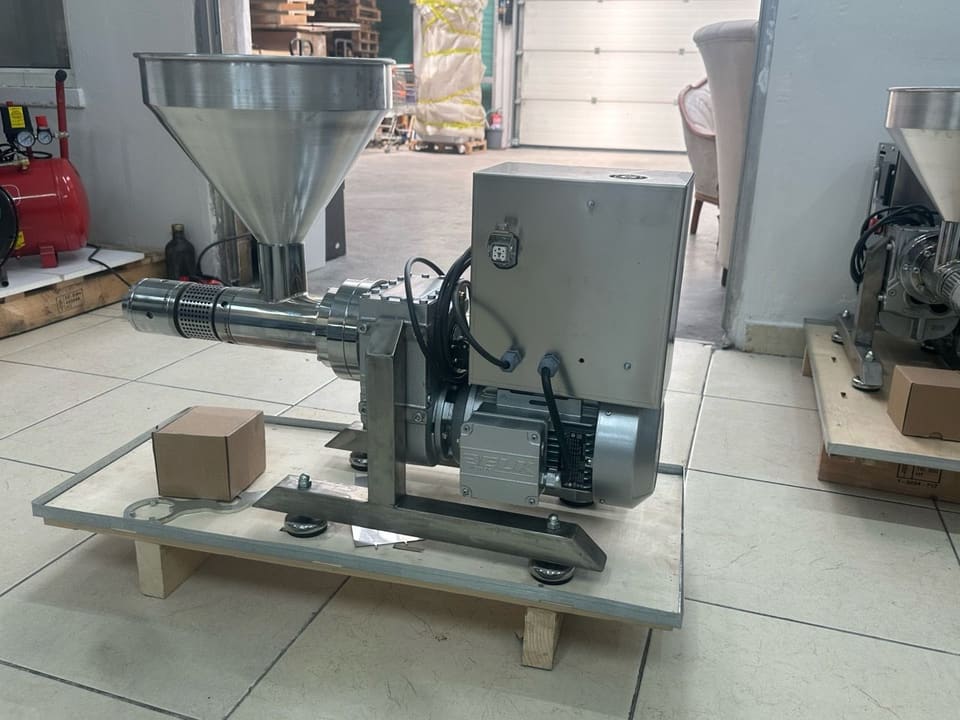
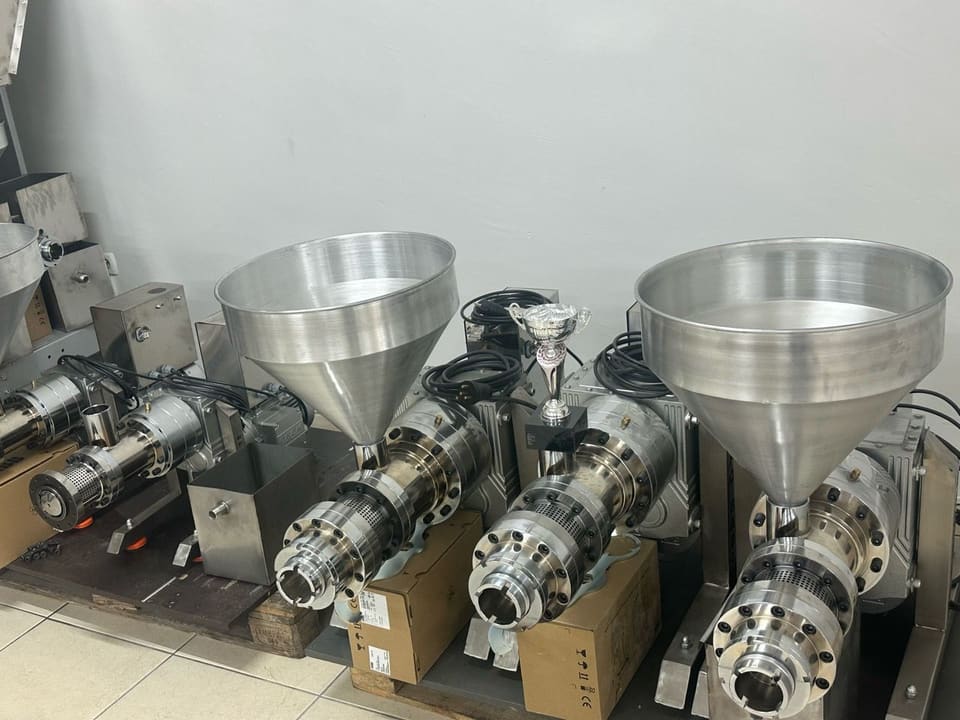
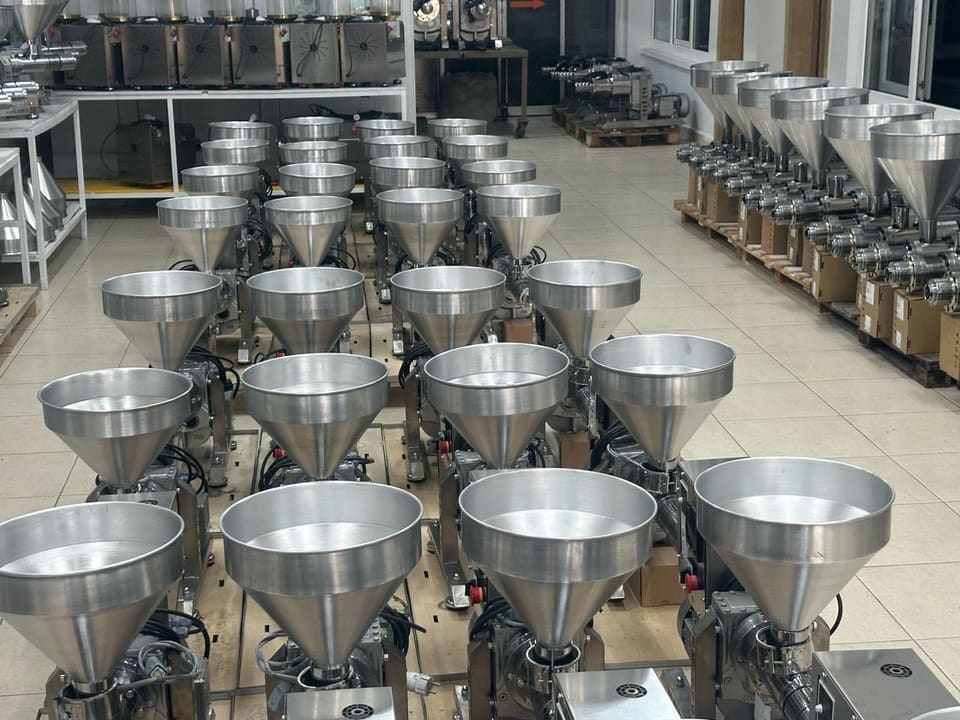
CSP-30 Industrial Cold Press Oil Machine
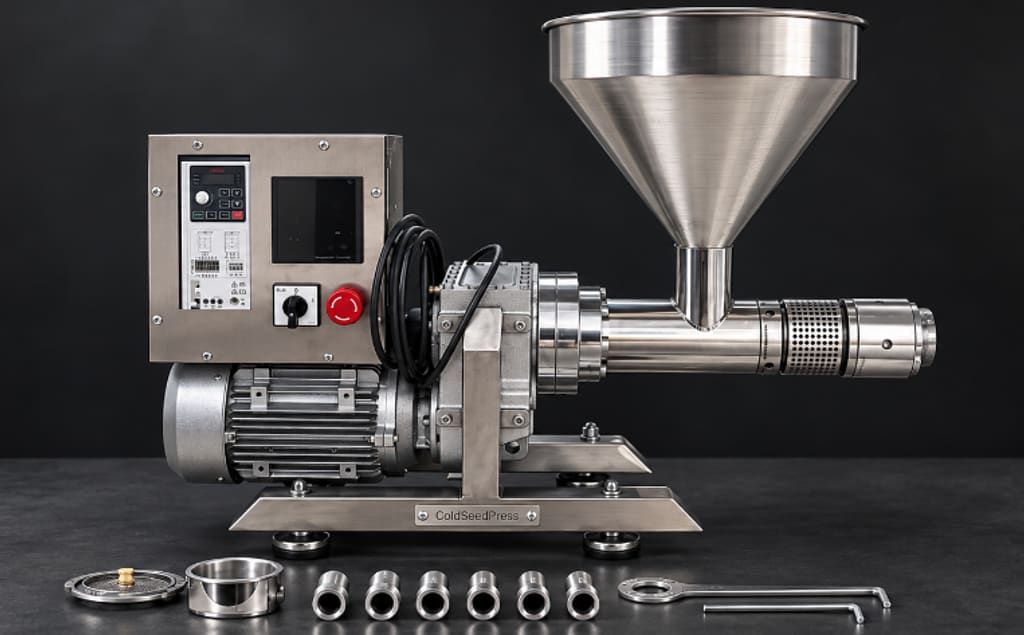
Cold press oil machine
CSP-30
Built for your production scale
- Efficient throughput
- 25–30 kg/h
- Rated daily capacity
- 720 kg / 24 h
- Operating power draw
- 1,500–2,500 W
- Residual oil in cake
- 3–5%
Manufacturer-stated figures
CSP-30 industrial cold press oil machine for mills and food producers. Three-phase, widest operating range, lowest cake residue. Request a quote.
The CSP-30 is the largest single-unit screw press in our range and the model we build for commercial production rather than sampling. It is designed for oil mills, food producers and contract pressers who run scheduled shifts and need consistent output day after day. It has the widest operating range and the lowest residual oil in the cake of any press we make. It runs on three-phase power, so the supply at your site has to be confirmed before you order.
What you can produce with it
Plan your production around the efficient throughput band, not the top of the operating range. At the efficient rate, a standard eight-hour shift puts roughly 200 to 240 kg of seed through the press. Two shifts double that. The 24-hour figure in the specification assumes near-continuous running with an operator present for feeding, cake removal and routine checks — treat it as the machine’s ceiling, not as an unattended target.
The wide operating range matters in practice. You can slow the press down for difficult, high-oil or high-moisture seed and let it work, or run it faster on clean, free-flowing seed. Sustained commercial output should still be planned at the efficient rate, with the upper end of the range kept as headroom.
For a small producer, this is the capacity point where pressing stops being a batch activity and becomes a production schedule. You can commit to a weekly volume for a buyer, plan bottling and labelling around a known daily figure, and know what raw seed you need to purchase to meet it. It is also the point where cake becomes a real second revenue stream rather than a by-product you give away.
Power supply
The CSP-30 is a 380V three-phase machine. The smaller presses in our range are 220V single-phase. This difference is the most common and most expensive mistake in export orders, because the machine cannot be swapped to single-phase after it ships.
Before you order, confirm four things at the installation site:
- Three-phase is actually available. Many workshops and rural sites only have single-phase. A three-phase connection may need an application to your utility and can take time.
- Your real line voltage. Grids described as “380V” are nominally 380, 400 or 415 depending on the country. Tell us your figure.
- Your frequency. 50 Hz and 60 Hz are not interchangeable for motor-driven equipment. Tell us which you have.
- Your cabling and protection. Size the supply cable, breaker and any isolator from the motor rating, not from the running draw you see on a meter. The press pulls more current at start-up and under heavy load than it does when running steadily on easy seed.
If you plan to run from a generator, size the generator on the motor rating plus the heater, with additional headroom for starting current. A generator sized to the average running load will trip.
Send us your voltage, frequency and phase configuration with your enquiry and we will confirm the machine is correct for your site before anything is built.
Cold pressing and cake residue
Residual oil is the oil still left inside the press cake after pressing. The CSP-30 is rated at the lowest residual oil figure in our range. That number is not a technical detail — it is the economics of the machine.
Every percentage point of oil left in the cake is oil you paid for in the seed and did not sell as oil. Over a single sack the difference is small. Over a production year at shift volumes it is significant, and it is the main reason a mill upgrades from a bench-scale press to an industrial one. Lower residue means more oil recovered from every kilogram of seed you buy.
At the same time, the cake is not waste. It leaves the press as a dry, firm solid and remains a sellable co-product, most commonly as animal feed. A well-pressed cake with low residual oil still has feed value, and it handles and stores better than an oily cake, which is more prone to going rancid. Selling both streams is how the machine pays for itself.
Cold pressing means the seed is not roasted or heat-treated before pressing. A small barrel heater is fitted, and its job is to bring the pressing head up to working temperature — mostly at start-up — not to cook the seed. This is what allows the oil to be sold as cold-pressed, which is the specification most food buyers and retailers ask for.
Seeds
The CSP-30 is stated to handle:
black cumin (nigella), sesame, flax/linseed, safflower, sunflower, pumpkin seed, walnut, almond, chia, hazelnut, peanut, canola/rapeseed, tea seed, argan, avocado, coconut/copra, soy, hemp seed, passion fruit seed.
Actual throughput is not the same for every seed. It changes with the oil content of the seed, its moisture level, how it was cleaned and stored, and the ambient temperature in your workshop. A dry, high-oil seed behaves very differently from a hard, low-oil one, and the same seed from two harvests can run differently.
Because of this we do not publish a per-seed throughput table — any number given without knowing your material would be a guess. If you tell us which seed you intend to run, we can test on request and give you a realistic figure for your material rather than a general one.
What to check before you order
A short checklist for importers. Most of these apply to any press you buy, from anyone.
Electrical
- Phase, voltage and frequency at the installation site, confirmed in writing
- The plug and connection type used in your country, and whether the machine is supplied with a plug or with bare leads
- Whether you need a local electrician for commissioning, and whether local rules require a certified installation
Spare parts and service
- Which parts are wear parts on a screw press, and how to order them
- Whether a spare parts set can ship with the machine, which is usually cheaper than shipping parts separately later
- How technical support is provided and in which language
- Which maintenance you can carry out yourself, and what tools it needs
Documentation to request
- Operating and maintenance manual in a language your operators read
- Electrical and wiring diagram
- Parts list with clear part identification, so you can reorder without guessing
- Any conformity, test or inspection documentation your customs authority or your own buyers require. Requirements differ by country — find out what your import rules demand, then ask the supplier what they can provide. Do not assume a marking you need will be there by default.
- Commercial documents your customs broker needs: invoice, packing list, certificate of origin, HS code classification
Packing and shipping
- Crate dimensions and gross shipping weight, which are not the same as the machine’s own dimensions and weight
- Whether the crate is built for sea freight and whether it meets wood packaging treatment rules for your country
- Incoterms — what the quoted figure covers and where your responsibility begins
- Whether the machine ships assembled or needs assembly on arrival
- How the machine is secured inside the crate, and what to inspect for transit damage before you sign for delivery
Your own site
- Door widths, access route, and whether you have lifting equipment for a machine of this weight
- Floor space around the press for feeding, cake collection and maintenance access
- Where oil and cake will be collected, filtered and stored
Request a quote
Tell us your seed, your target daily volume, and your site’s voltage, frequency and phase. We will confirm whether the CSP-30 is the right model for you and prepare a quotation.